Introduction
Technology has become a critical part of how modern businesses operate, compete and grow. From cloud infrastructure and enterprise software to digital transformation and integrated business systems, organisations increasingly depend on technology to improve efficiency, strengthen security and support long-term business goals.
However, choosing the right technology solution or IT service provider is not always straightforward. Business leaders must consider costs, technical requirements, scalability, security, integration and the potential impact on their existing operations. IT teams must also ensure that the selected solutions align with the organisation’s infrastructure and future technology roadmap.
This makes the B2B IT buying journey more complex than a typical purchasing decision. It often involves multiple stakeholders, detailed research, technical evaluations and ongoing collaboration.
Understanding this journey can help IT companies and technology service providers build stronger relationships with potential clients, while helping businesses make more informed technology decisions.
1. Understanding the B2B IT Customer Journey
The B2B IT customer journey describes the stages an organisation goes through when identifying a technology challenge, researching possible solutions, evaluating providers, making a purchasing decision and developing a long-term partnership.
Unlike individual consumer purchases, business technology decisions usually involve several departments. For example, an organisation considering a cloud migration may involve its IT department, finance team, operations managers, security specialists and senior leadership.
Each stakeholder has different priorities:
- IT teams focus on technical compatibility, performance, security and maintenance.
- Business leaders evaluate strategic value, operational improvements and return on investment.
- Finance teams assess costs, budgets and long-term financial commitments.
- Procurement teams review vendor reliability, contracts and commercial terms.
- Operations teams consider implementation, employee adoption and business continuity.
For technology providers, understanding these different priorities is essential to creating a successful B2B customer experience.
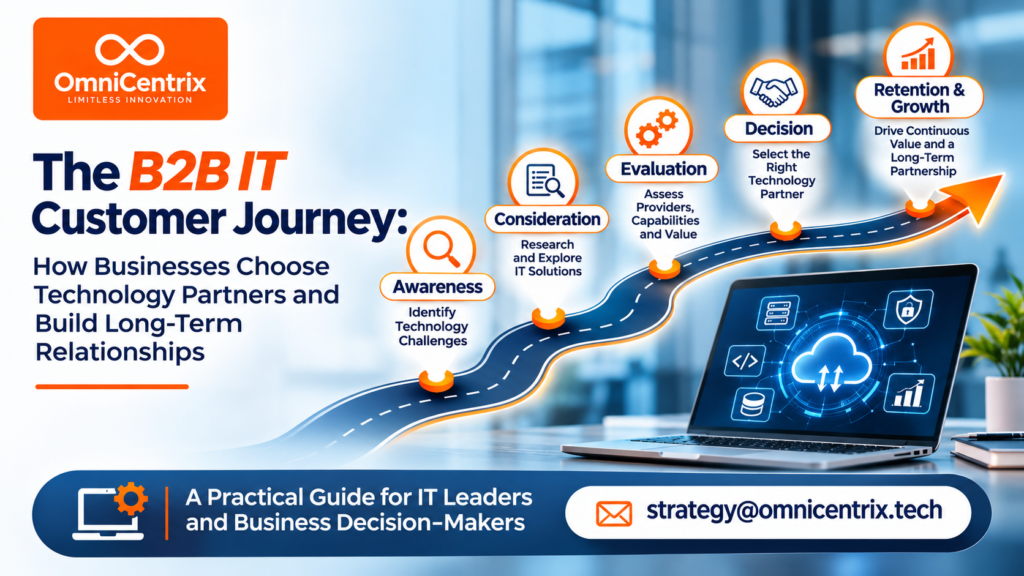
2. The Five Stages of the B2B IT Customer Journey
Stage 1: Awareness – Identifying Technology Challenges
The journey begins when an organisation recognises a technology-related challenge or business requirement.
Common situations include:
- Outdated IT infrastructure affecting performance.
- Increasing cybersecurity concerns.
- Difficulty integrating different business applications.
- Inefficient manual processes.
- Limited visibility into business data.
- Growing operational requirements that existing systems cannot support.
At this stage, organisations begin researching possible solutions. They may explore industry articles, technical guides, webinars, case studies and recommendations from technology professionals.
How IT companies can support this stage:
Technology providers should publish educational content that addresses real business and technical challenges. Practical articles, solution guides and industry insights can help decision-makers understand their options before approaching a provider.
Stage 2: Consideration – Researching Possible Solutions
Once an organisation understands its challenge, it begins exploring different approaches.
For example, a business experiencing infrastructure limitations may compare cloud migration, infrastructure upgrades and hybrid cloud solutions.
During this stage, decision-makers may evaluate:
- Technical capabilities and compatibility.
- Security and compliance requirements.
- Scalability and future readiness.
- Implementation complexity.
- Support and maintenance arrangements.
- Estimated costs and expected business benefits.
Technology providers can build credibility by explaining how their solutions work, outlining implementation considerations and helping organisations understand the advantages and limitations of different approaches.
Clear technical information and relevant business examples are particularly valuable at this stage.
Stage 3: Evaluation – Assessing Technology Partners
After identifying potential solutions, organisations begin comparing technology providers.
This is an important stage because businesses are not simply purchasing software or IT services. They are evaluating whether a provider can understand their requirements and support their long-term objectives.
Important evaluation factors include:
Technical expertise: Does the provider have the knowledge and experience required to address the organisation’s technology needs?
Business understanding: Can the provider connect technical recommendations with measurable business objectives?
Security and reliability: Does the proposed solution address data protection, system reliability and relevant compliance requirements?
Integration capabilities: Can the solution work with the organisation’s existing applications and infrastructure?
Scalability: Will the technology continue to support the business as its requirements grow?
Support and communication: Can the provider offer clear communication, implementation guidance and ongoing support?
For IT companies, demonstrating both technical expertise and an understanding of business requirements can make a significant difference during this stage.
Stage 4: Decision – Selecting the Right Technology Partner
Once the evaluation is complete, the organisation moves towards selecting a provider and finalising the project.
This stage may involve technical discussions, proposals, demonstrations, budget approvals, contract reviews and implementation planning.
However, the lowest-cost option is not necessarily the best choice.
Businesses should consider the overall value of a solution, including its long-term operating costs, reliability, scalability, integration requirements and expected contribution to business performance.
A well-defined implementation plan is also important. It should establish project responsibilities, timelines, resource requirements, communication processes and success criteria.
Technology providers can build confidence by presenting realistic proposals, explaining technical decisions clearly and setting transparent expectations.
Stage 5: Retention and Growth – Building a Long-Term Partnership
The relationship does not end once a technology solution is implemented.
Organisations need to monitor performance, resolve technical issues, adapt to changing requirements and identify opportunities for improvement.
For example, a business that initially works with an IT provider for infrastructure modernisation may later require cloud optimisation, business application integration, automation or additional technology consulting.
Long-term partnerships are strengthened through:
- Regular performance reviews.
- Proactive technical support.
- Continuous improvement recommendations.
- Clear communication.
- Technology upgrades and optimisation.
- Alignment with changing business objectives.
For technology providers, ongoing value and reliable support are essential to building trust and encouraging long-term client relationships.
3. Common Challenges in the B2B IT Buying Journey
Even when organisations understand their technology requirements, several challenges can affect their decision-making process.
Unclear Technology Requirements
Businesses sometimes identify a technical problem without fully understanding its underlying cause. Investing in a solution before assessing the actual requirement can result in unnecessary costs or incomplete outcomes.
What helps: Conducting a technology assessment before selecting a solution can help identify gaps, priorities and practical requirements.
Integration with Existing Systems
New technology must often work alongside existing applications, databases and infrastructure. Poor integration can create operational difficulties and additional maintenance requirements.
What helps: Reviewing the existing technology environment and defining integration requirements before implementation.
Security and Compliance Concerns
Data protection, access management, system security and regulatory requirements are important considerations when evaluating technology solutions.
What helps: Including security requirements in the initial planning and evaluation process rather than treating them as an afterthought.
Budget and Return on Investment
Technology investments can involve implementation costs, licensing, infrastructure, training and ongoing maintenance.
What helps: Evaluating the total cost of ownership and expected business outcomes rather than considering only the initial purchase price.
Communication Gaps Between Business and IT Teams
Business teams may focus on operational outcomes, while IT teams concentrate on technical requirements. Without effective communication, projects can lose alignment with business priorities.
What helps: Establishing shared objectives and involving relevant stakeholders throughout the decision-making process.
4. How Technology Helps Improve the B2B Customer Journey
Technology can also help IT companies and B2B service providers manage their own customer relationships more effectively.
Several solutions can support this process.
Customer Relationship Management (CRM)
CRM systems help organisations maintain a centralised view of prospects, customer interactions, enquiries and sales opportunities.
For B2B technology providers, this makes it easier to manage long sales cycles, coordinate follow-ups and maintain communication across multiple stakeholders.
Marketing Automation
Marketing automation helps businesses deliver relevant information to prospects based on their interests and engagement.
For example, an organisation researching cloud migration may receive relevant educational resources, technical guides or information about infrastructure consulting.
This helps maintain engagement without relying entirely on manual communication.
Data Analytics and Reporting
Analytics tools help organisations understand how prospects interact with their content, which channels generate enquiries and where potential customers disengage.
These insights can help marketing and sales teams improve their strategies and focus on more relevant opportunities.
Integrated Business Systems
Integrating CRM, marketing, sales and operational systems can reduce information gaps and improve coordination between departments.
When teams have access to consistent information, they can provide a more connected and informed customer experience.
5. Measuring the Effectiveness of the B2B IT Customer Journey
Understanding customer behaviour is useful, but organisations also need measurable indicators to evaluate performance.
Some important metrics include:
| Metric | What It Helps Measure |
|---|---|
| Target-industry website traffic | Whether the business attracts relevant organisations |
| Qualified enquiries | The number of enquiries from potential business clients |
| Consultation requests | Interest in discussing specific technology requirements |
| Lead-to-opportunity conversion | How effectively enquiries become genuine sales opportunities |
| Proposal acceptance rate | How often submitted proposals lead to business agreements |
| Sales cycle length | The time required to move from initial enquiry to decision |
| Customer acquisition cost | The cost of acquiring a new business client |
| Client retention rate | The ability to maintain long-term business relationships |
| Referral rate | The level of trust and satisfaction among existing clients |
These metrics should be considered together. For example, a high number of website enquiries may not necessarily indicate success if those enquiries do not come from the organisation’s target industries.
The goal is to attract relevant business opportunities and build relationships that create long-term value.
6. Practical Example: Choosing an IT Partner for Digital Transformation
Consider an organisation experiencing operational inefficiencies because its departments use disconnected software applications and outdated infrastructure.
The IT team identifies the need to modernise its technology environment. However, senior management also wants to understand how the investment will improve productivity, reduce operational difficulties and support future growth.
The organisation begins researching technology options, including infrastructure modernisation, system integration and business process automation.
During the evaluation stage, it compares providers based on technical expertise, security, integration capabilities, implementation plans and long-term support.
After selecting a suitable technology partner, the organisation begins implementation with clearly defined objectives and responsibilities.
Once the project is completed, the partnership continues through system monitoring, optimisation and additional technology improvements.
This example demonstrates why successful B2B IT relationships require more than technical delivery. They depend on understanding business priorities, communicating effectively and providing continuous value.
7. A Practical Checklist for Businesses Choosing an IT Partner
Before selecting an IT service provider or technology partner, organisations should consider the following:
- Have we clearly identified our business and technology requirements?
- Have we assessed our existing IT infrastructure and systems?
- Does the proposed solution align with our business objectives?
- Have we reviewed security, compliance and data protection requirements?
- Can the solution integrate with our existing environment?
- Is the solution scalable for future business needs?
- Have we evaluated the total cost of ownership?
- Does the provider have relevant technical and consulting expertise?
- Are implementation responsibilities and timelines clearly defined?
- Is ongoing support and continuous improvement available?
A structured evaluation can help organisations make better technology decisions and reduce the risks associated with IT investments.
8. How OmniCentrix Supports Business and Technology Transformation
Successful technology decisions require a clear understanding of both business objectives and technical requirements.
OmniCentrix works across business and technology-focused areas, helping organisations explore solutions that support their operational and strategic needs.
Its service areas include:
- IT Consulting & Advisory: Supporting organisations with technology planning and IT-related decision-making.
- Business Consulting & Advisory: Helping businesses align their operational requirements with broader business objectives.
- MarTech Solutions: Supporting marketing technology, automation and data-driven business engagement.
- HRTech Solutions: Helping organisations explore technology-enabled approaches to HR processes.
- InfraTech (PropTech & RealTech): Addressing technology needs across infrastructure, property and real estate-related environments.
By connecting business requirements with technology considerations, OmniCentrix aims to help organisations approach digital transformation with greater clarity.
To learn more, explore OmniCentrix’s technology and consulting solutions.
Conclusion
Choosing the right IT solution or technology partner is an important business decision. It requires organisations to understand their requirements, evaluate available options, consider long-term value and ensure that technology investments support their wider objectives.
For IT companies and B2B technology providers, understanding the customer journey is equally important. Building trust requires more than presenting technical capabilities. It involves communicating business value, addressing stakeholder concerns and maintaining strong relationships beyond implementation.
As technology continues to shape business operations, organisations that approach technology decisions strategically will be better positioned to adapt, innovate and grow.
Looking to align your business goals with the right technology strategy?
Connect with OmniCentrix to explore technology and consulting solutions that support your organisation’s evolving needs.
Website: https://omnicentrix.tech/
Email: strategy@omnicentrix.tech